Not knowing as strategy
Strategy begins by sensing what has not yet taken form, holding uncertainty, and acting with judgment and responsibility in a changing world.
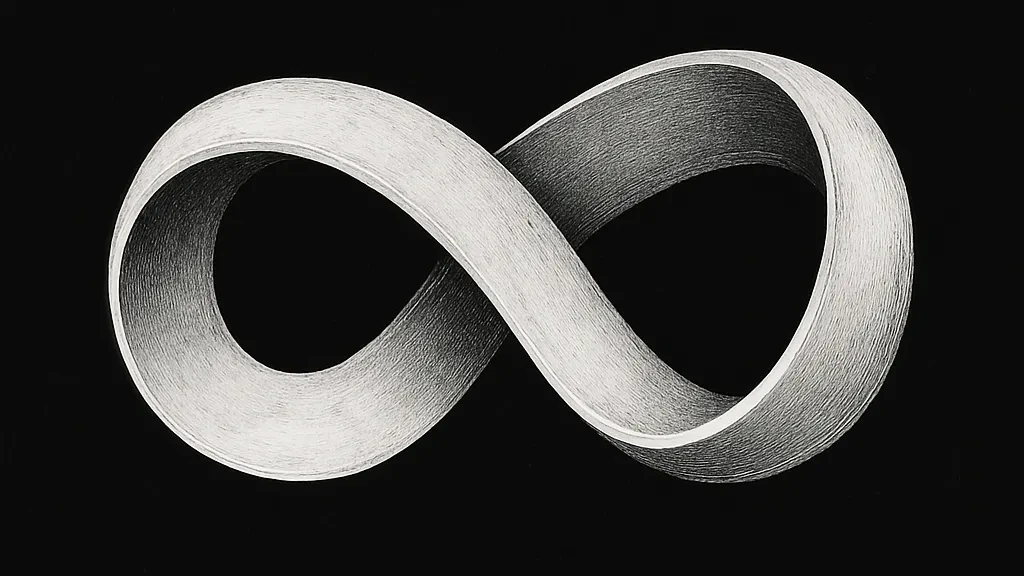
Will AI transform strategy? More data, faster iterations, better predictions. But is that strategy? or just hyper-optimization?
I have this hypothesis: That true strategy begins before the plan, and resists being captured by code. It emerges where language hasn’t yet formed, where time is still plastic, and where action involves exposure, not automation. But this requires a reframing of what kind of intelligence strategy actually requires.
Strategy is not a plan. Strategy is a gesture that moves through time. It begins before thought (as in Água Viva), pulses as a virtual vector (as Bergson proposes), folds into tactical modules (in Deleuzian terms), and only reveals itself when embodied in action, when the world responds, and where ethics comes into play (as Arendt reminds us).
Perhaps the mistake is treating strategy as something that can be planned, executed, and measured. I think of Sari Azout’s video when she says that we end up measuring the things that are least meaningful, just because they are measurable.
But what if strategy is something more subtle, more vibrational, less tame?
⸻
A living rhythm
Clarice Lispector, in Água Viva, writes: “I want what is not yet.” I got fascinated by this book, and how it feels to read it. To me, it is like reading my thoughts during Carnival, a flux of waves unfolding the most different enchantments, triggered by the happy people in the streets, the costumes, the dancing, the music. It is all about intensities.
And maybe that’s where strategy begins too: not in logic, but in attunement.
Strategy, in this sense, would be the art of sensing a rhythm before it solidifies. It doesn’t emerge from logic, but from sensitivity. It feels like being caught by a beat you can’t resist. Or staring at a photo that suddenly stirs something in you. Or watching a scene in a film that echoes something unspoken. You listen, you see, you hear.
Before it becomes a plan, strategy is a tuning. A nameless gesture, arising from contact with a field in motion. Can AI access this? Can a machine feel the world before the world reveals itself?
⸻
Fossilized strategy
Strategy Safari (Mintzberg et al.) tries to map “ten schools” of strategic thinking: design, positioning, learning, culture, and so on. But what it offers, in practice, is a conceptual zoo: a catalog of frozen forms.
Each “school” represents an attempt to reduce strategy to a dominant model. But perhaps what we call strategy happens between these schools: in the margins, in the glitches, in the misalignments.The Safari promises a forest, but only delivers fossils. It’s the kind of strategy delivered by a framework, by a person that is just following the guidelines, it does not have the drive, the intention, it’s not embbeded.
The danger is to believe that naming is understanding, and that understanding is knowing what to do.
⸻
The virtual vector (Intuition)
Henri Bergson suggests that the virtual is not unreal, it’s what hasn’t yet been actualized. He calls this duration: a non-linear, living time where novelty can emerge. If we accept that, then strategy is not about prediction. It’s about opening to what time wants to become. It’s the gesture before the act facing what you have not predicted: You enter a prompt unsure of what to ask, and what returns is an answer you don’t know how to explain, where it emerges the tremble, what are you going to do?
It doesn’t try to control the future, it listens to it. It takes shape as a vector, an invisible line of force that’s already acting before it fully appears. The question shifts: not “how do I predict what’s coming?” But “how do I position myself in relation to what’s asking to emerge?” Then embbeded by my knowledge, my values, my guidelines for life, I come up with an act.
Most AI works on past-to-future projection. It simulates change, but often in static terms, meaning AI operates with predictable logic not a moving world. And strategy, at its core, is about invention.
⸻
Test of the world
Hannah Arendt reminds us that the world only changes when someone acts. Action exposes thought to risk, to collectivity, to judgment. In this light, strategy only becomes real when it passes through the body and enters the world.
This is where AI becomes most ambiguous: When it generates actions (a decision, a recommendation, a design), where is the subject? Where is the one who stands behind the gesture? True strategy doesn’t hide behind the interface. It risks. It enters the world. And it bears responsibility.
The strategic gesture is always a wager. It is confirmed, or not, when it rubs against reality. This is where ethics enters: not as an external code, but as responsibility for what is set in motion.
Every true strategy involves risk, exposure, and relation. It is never neutral, it always transforms something, including the one who acts. So maybe the issue isn’t that AI can’t be strategic — but that it removes the conditions under which strategy means something: exposure, relationality, judgment, and care. After the act, the world has changed. And responsibility for what was set in motion does not allow retreat..
⸻
A rhizomatic reading
With Deleuze, we can read strategy as a tactical module: something that connects and disconnects, acts locally, resists totality. Strategy here is not structure or master plan. It is assemblage. A fold. A choice that emerges from within, not from above. (The type of thing we improvise, an act after the unpredictable event. Playing, Jogo de Cena de Eduardo Coutinho, shows it how it happens.)
AI may soon become excellent at deploying modular tactics. But can it recognize when to connect? Can it sense the rhythm of entry and exit?
This perspective resists the treatment of strategy as something fixed or inherently scalable. It is rhizomatic: scattered, partial, unstable. That timing — that attunement — may still belong to us.
But that’s precisely where its power lies. It adapts to the forces of the present, without surrendering to them.
⸻
But what if strategy were not a plan, but a form of listening? A listening to time, to context, to oneself in relation to others? Maybe the most strategic thing today is this: To relearn how to feel what has no name yet. To hold the not-knowing.
The not-knowing: the moment when something unprecedented is allowed to happen, and someone stands behind it.
Filed Under
I’m a designer working at the intersection of strategy, services, and AI, usually in complex organizational contexts. I help teams translate ambiguity into decisions, frameworks, and work that can actually be adopted.