The Alfred to My Batman
Empowering teams through invisible design. From overload to orchestration.
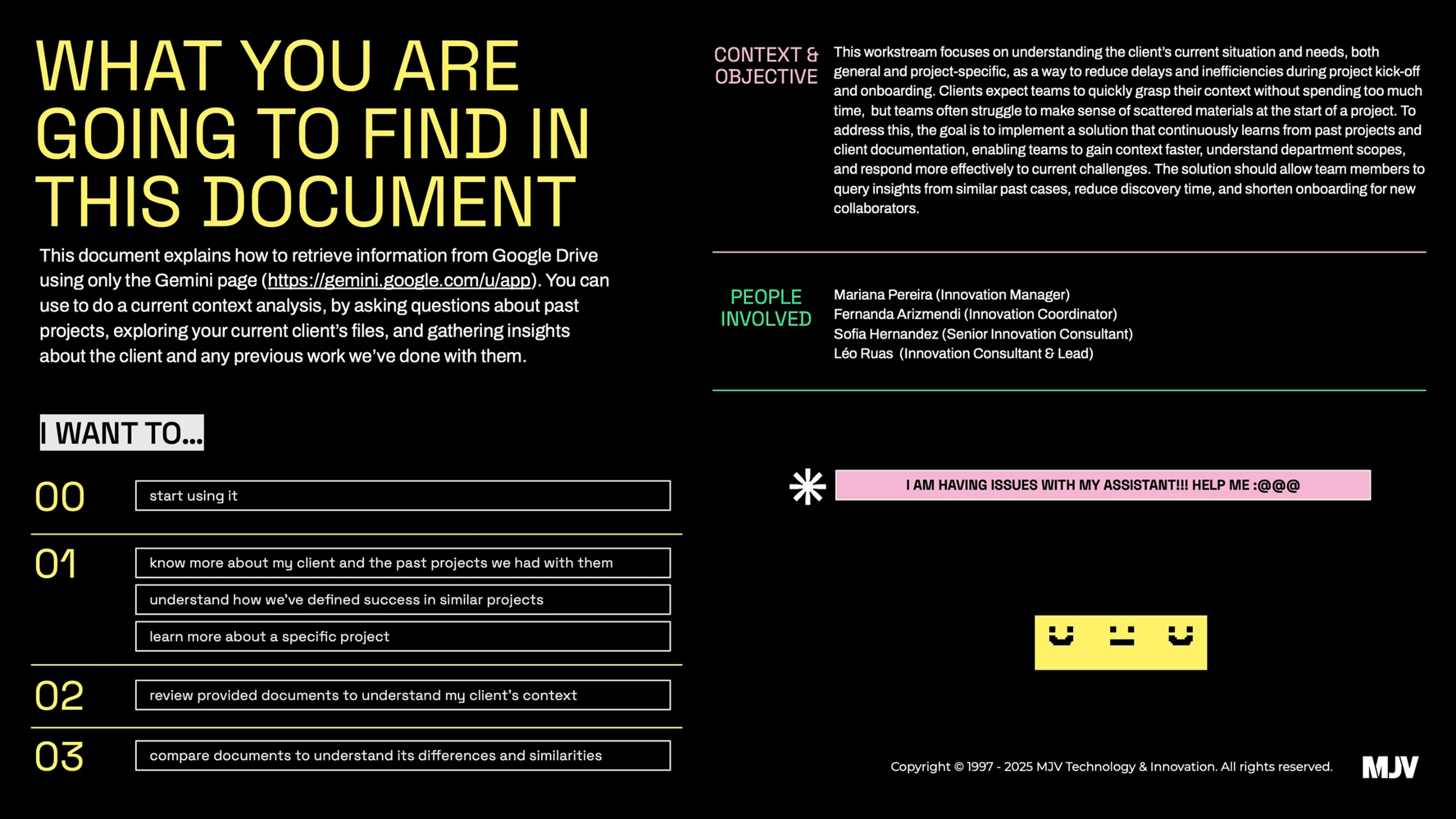
Timeline2025
ClientMJV Innovation & Technology
2 min read
Our leadership team was facing a recurring problem: despite a growing demand for project context analysis, the process remained manual, scattered, and slow. They wanted to explore the use of Gemini and file uploads to accelerate this work — but there was no defined system, just a rough intention.
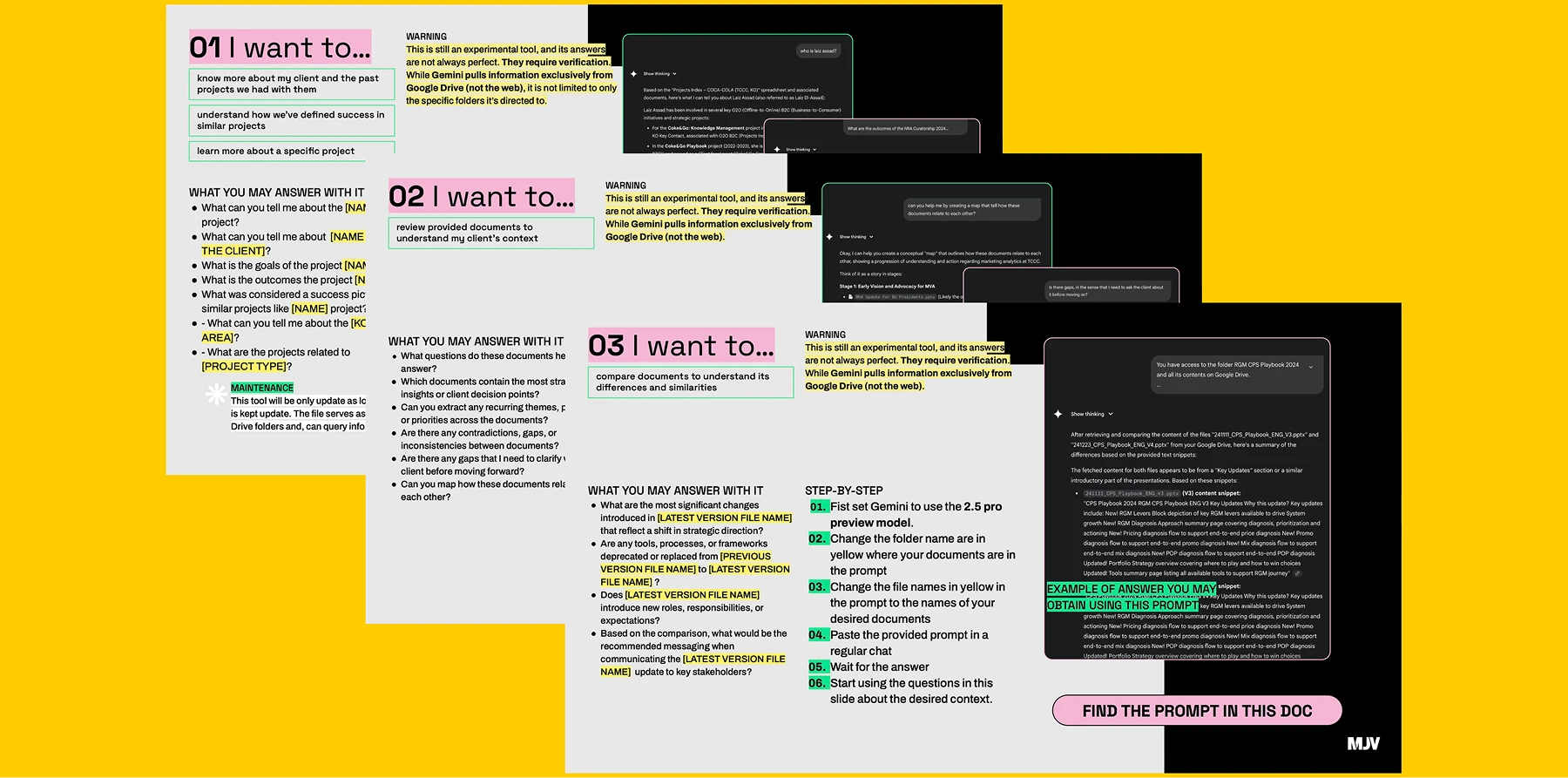
I took the initiative to test a new approach using Google Sheets and Google Drive. The goal: build a bridge between project documentation and automated intelligence, creating a system that could extract, organize, and generate insights across multiple projects — without requiring teams to upload files manually.
CHALLENGE
- How can we automate context analysis without losing nuance?
- Can an AI system navigate a real project archive (Google Drive) with structure and purpose?
- What would a smart but invisible workflow look like?
APPROACH
- Analyzed documentation pain points and identified where manual effort was being lost
- Created a Sheets system linking each project to its full folder of source materials
- Structured Gemini prompting logic to navigate project folders and generate context insights
- Designed new workflows to extract insights, generate summaries, and create first-draft documents using AI
IMPACT
- Enabled faster and more consistent analysis of past projects
- Reduced reliance on memory or manual digging through files
- Provided strategic inputs for new briefs, frameworks, and documents
- Demonstrated a low-code model of AI integration, adaptable to other team rituals
WHAT I LEARNED
- AI isn’t useful by default — it needs structure to become meaningful
- Documentation isn’t just a record — it’s a terrain for design
- Invisible systems often create the most visible change