Project Worlds
How LLM Wikis became the cognitive infrastructure behind my work
Alfred was my first attempt at building an external memory.
The idea was simple: instead of treating notes as static documents, I wanted knowledge to become conversational. At the time, however, that ambition was limited by the available technology. Information could be stored, organized, and searched, but it could not actively participate in reasoning.
Early this year, Andrej Karpathy coined the term LLM Wiki to describe a wiki designed to work alongside large language models rather than traditional search. That idea immediately resonated with me because it represented the missing piece Alfred never had.
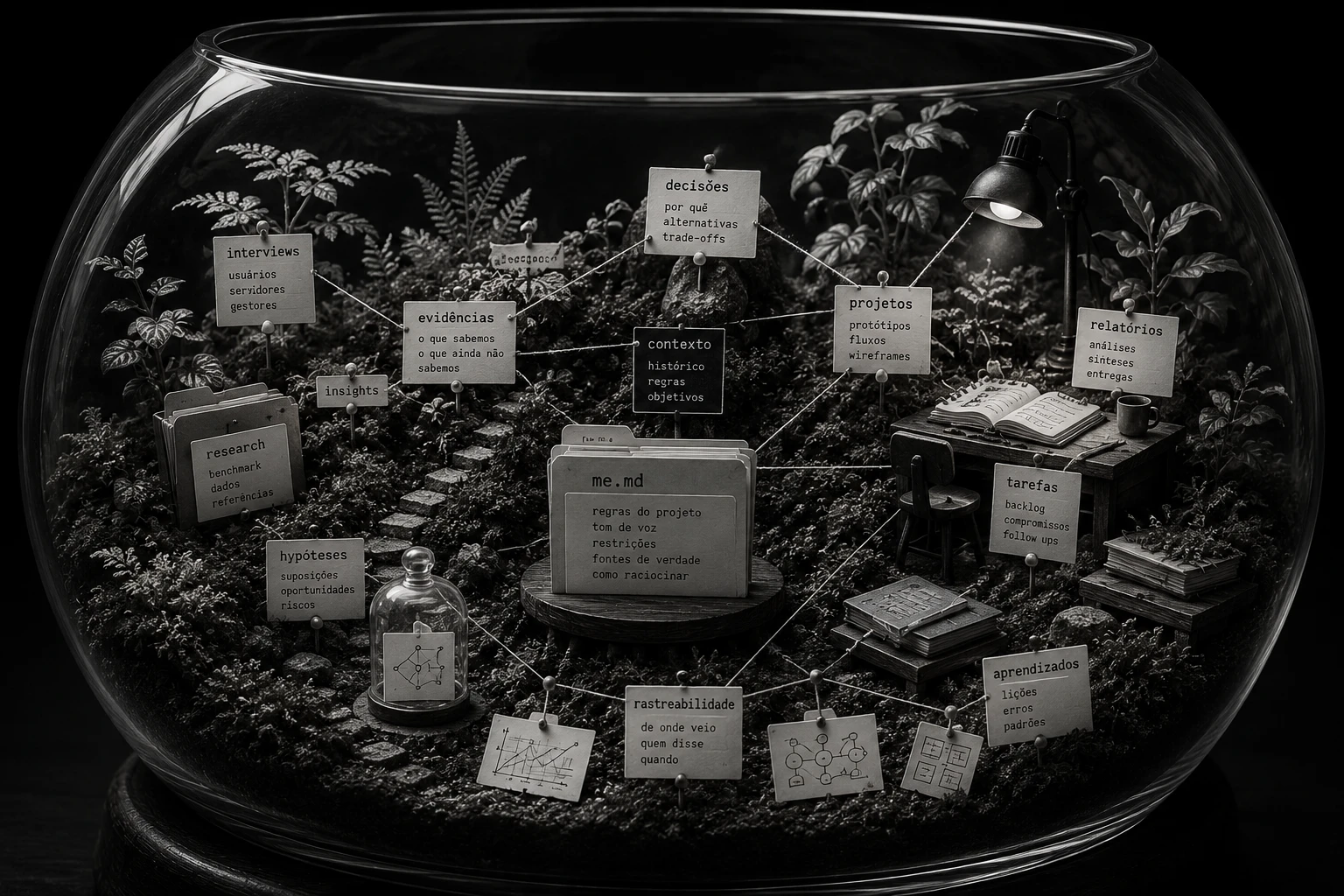
For me, however, an LLM Wiki is more than searchable documentation. It is the cognitive infrastructure of a project.
Over time, I realized that every meaningful project eventually becomes a world of its own. It develops its own language, history, constraints, people, decisions, failures, rituals, and unresolved questions. Traditional tools fragment that world across documents, chats, presentations, tickets, spreadsheets, and folders. An LLM Wiki reconstructs it as a single conversational environment where memory can accumulate instead of constantly restarting.
Today almost every long-running project I have lives inside its own LLM Wiki.
Pouppy has its own world. Product decisions, architecture, experiments, prompts, implementation details, and future ideas all become part of a shared memory that allows conversations to resume naturally months later.
The redesign of the IFMG Portal has another. Interviews, workshop notes, meeting transcripts, analytics, research findings, AI outputs, design decisions, reports, prototypes, and an evolving task list all coexist in the same environment.
At one point this became unexpectedly useful. I realized I was forgetting small commitments made during interviews and meetings: things I had promised to investigate, revisit, or deliver. Instead of manually rereading dozens of transcripts, I simply asked the agent to reconstruct every commitment from the project’s history. The wiki wasn’t retrieving documents. It was reconstructing continuity.
As the project grew, another concern emerged: traceability. The problem was no longer finding information, but trusting the reasoning built on top of it. Every recommendation needed to remain connected to the interviews, reports, analytics, or decisions that justified it.
This led me to experiment with project constraints instead of relying exclusively on prompts. Persistent instructions, structured documentation, and files such as me.md establish explicit rules for how the agent should reason, distinguish evidence from interpretation, acknowledge uncertainty, and cite the project’s own history. Rather than optimizing for convincing answers, the goal became making every conclusion inspectable. The wiki gradually evolved from conversational memory into an environment for traceable reasoning.
Other worlds emerged naturally. My nutrition wiki combines recipes, pantry inventory, nutritional data, food prices, protein-per-real calculations, meal planning, shopping history, and gym tracking into a single evolving conversation.
My Design Archaeology wiki accumulates investigations about everyday artifacts and the relationships between them. A water bottle, a camera, a cigarette, a login screen, and a calendar are no longer isolated essays. They become part of a growing conceptual landscape where every new artifact inherits context from previous ones.
Looking back, I no longer think an LLM Wiki is a form of knowledge management.
It is a way of preserving the continuity of a world. This also changed how I think about AI itself. In my essay Time is Un-LLM-able, I argue that language models cannot experience lived time. They do not accumulate memories, responsibilities, or histories in the human sense. An LLM Wiki does not solve that limitation. Instead, it preserves the continuity of a project so that humans and agents can continue reasoning from a shared history rather than repeatedly beginning from zero.
The goal was never to build a better notebook. It was to create worlds that remember enough for meaningful work to continue.
Filed Under
I’m a designer working at the intersection of strategy, services, and AI, usually in complex organizational contexts. I help teams translate ambiguity into decisions, frameworks, and work that can actually be adopted.